Your first order, in three steps
- Choose the broth and heat level before the ingredients.
- Start with a small selection your group understands; ask about plate sizes.
- Keep raw and cooked utensils separate, and ask staff about cooking each ingredient.
1. Start with the broth, not the meat
The classic red broth is rich with beef tallow, chilies and Sichuan pepper. The chilies bring heat; Sichuan pepper brings a tingling, numbing sensation. That combination is málà — 麻辣.
On a hotpot menu, 牛油 (niúyóu) means beef fat, or tallow. Do not mistake it for dairy butter. Recipes vary, so check the broth before choosing what will go into it.
If you are unsure about the heat, ask whether a split pot — 鸳鸯锅 (yuānyāng guō) — is available, with a spicy broth and a non-spicy alternative. Confirm the actual broths and ask for the spicy side to be mild. A restaurant’s “mild” is not a promise that it will feel mild to you.
2. Nine grids are not nine different broths
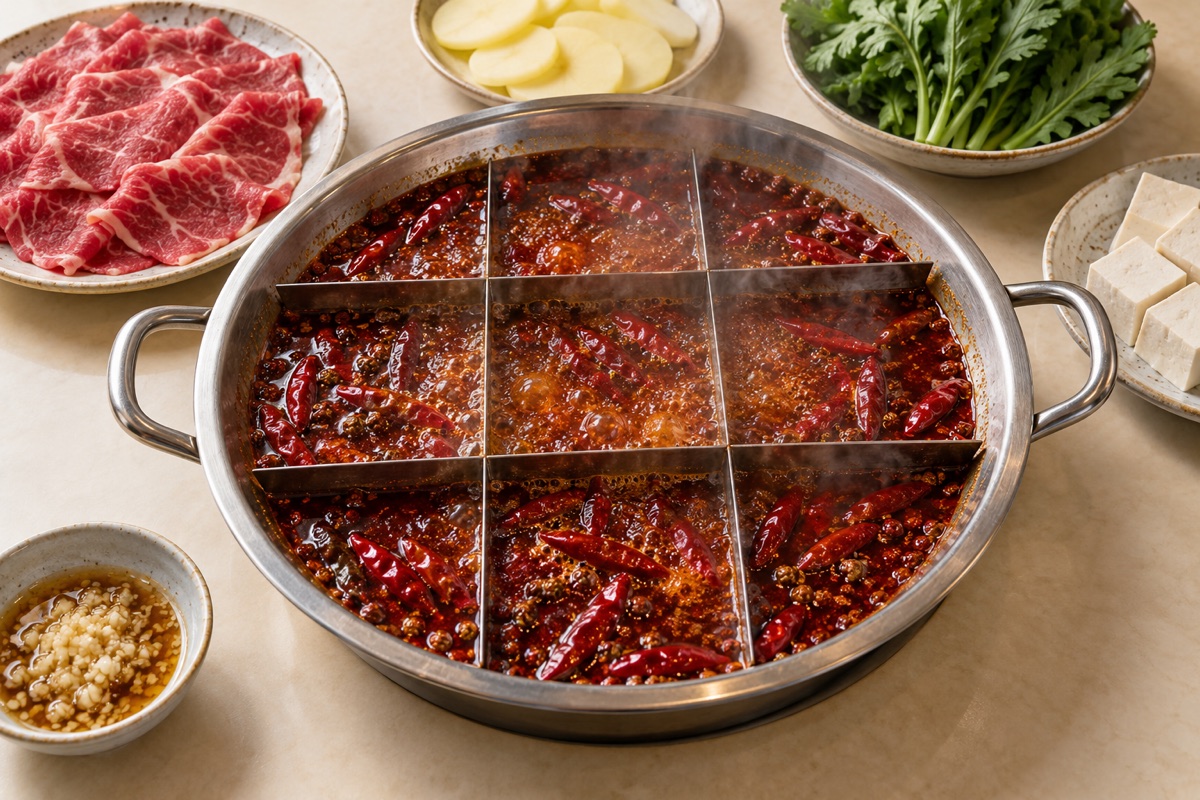
The photogenic 九宫格 (jiǔgōnggé) pot has a grid dividing its surface. In the traditional arrangement, the broth connects underneath. The sections help organize the food; they are not nine separate flavors or a built-in non-spicy corner.
If someone needs a different broth, ask for an actual divided pot. If they need food kept separate for dietary reasons, explain that too: a divider does not settle questions about utensils, splashes or how the broths were prepared.
How the nine-grid pot works3. Decode the menu before you tick the boxes
Choose familiar ingredients first, then add something new if it appeals to you. Here are names you may encounter; the restaurant’s menu determines what is available.
| Menu name | What it means | Before you order |
|---|---|---|
| 牛肉片 · niúròu piàn | Beef slices | Ask whether they are plain or marinated. |
| 毛肚 · máodǔ | Cattle tripe — stomach tissue | Choose it for its texture if offal appeals to you; ask staff how to cook this preparation. |
| 黄喉 · huánghóu | Aorta, commonly from a pig or cow | The literal “yellow throat” translation is misleading. Confirm the animal source. |
| 豆腐 · dòufu | Tofu | Check the broth and any marinade if you avoid animal ingredients. |
| 土豆片 · tǔdòu piàn | Potato slices | Cook them through; thickness affects cooking time. |
| 金针菇 · jīnzhēngū | Enoki mushrooms | Cook them thoroughly rather than treating them as a raw garnish. |
For a first order, consider a meat you recognize, tofu or another soy product, and a couple of vegetables that your group likes. Treat that as a starting mix, not a fixed portion guide. Ask about plate sizes and whether half portions are offered before ordering more.
4. Give the dipping bowl its own moment
A Chongqing-style starting point is sesame oil with minced garlic. Other condiments are a matter of the restaurant and your preference; you do not need to combine everything on the sauce counter.
Try a little sauce, then adjust it. If you avoid a particular ingredient, check the oil and any mixed sauces rather than relying on appearance. The sauce adds flavor; it does not make undercooked food ready to eat.
5. Cook a little at a time — and ask about unfamiliar cuts
Keep raw-food utensils separate from the ones you use to eat or retrieve cooked food. Add manageable batches, and make sure the food is cooked thoroughly. If staff top up the broth, let it return to a boil before adding more food.
A few dips or a fixed number of seconds cannot tell you whether every ingredient is done. Thickness, preparation and the heat of the pot matter. Ask staff to demonstrate with the actual ingredient you ordered.
Lift a cooked piece onto your plate and let it cool before taking a bite. You can enjoy the food without rushing straight from the bubbling pot.
Hotpot food-handling guidance6. Vegetables in the pot do not make the meal vegetarian
The red broth may already contain beef tallow. A non-spicy or tomato-flavored base can also use animal stock. Choosing tofu and vegetables does not change what they are being cooked in.
If you eat vegetarian or vegan, explain your requirements before ordering and ask about the broth, seasonings, dipping sauce and separate equipment. Do not assume a restaurant can provide a suitable setup just because it offers a split pot.
For children, choose according to their usual eating needs and let an adult handle the hot pot. Keep sauces optional, let food cool, and check ingredients rather than treating “non-spicy” as an all-purpose suitability label.
Beef-tallow base · Broth recipe examples7. Ask what the order includes before you commit
Before sending the order, check how the broth, ingredient plates, dipping sauces and any other charges are listed. Prices and charging arrangements depend on the restaurant; a menu photograph from someone else’s trip is not your bill.
Then confirm three things with your table: everyone understands the broth choice, the ingredients are ones you actually want to try, and you know who to ask about cooking them. There is no need to order the most unfamiliar item to make your first hotpot meal worthwhile.
Mild clear broth / Tomato broth / Mushroom broth
有番茄锅底或菌汤锅底吗? — Do you have tomato or mushroom broth?
这个锅底加辣椒吗? — Does this broth contain chili?
这是用鸡汤、骨汤,还是蔬菜汤做的? — Is this made with chicken, bone or vegetable stock?
可以做一边辣、一边不辣的鸳鸯锅吗? — Can we have a divided pot with one spicy side and one non-spicy side?
Before you order
- Confirm the ingredients in the broth, not just its color.
- Check the price of the broth, dipping sauces and ingredient plates.
- Ask for separate equipment if dietary requirements call for it.
Phrases to show at the table
有鸳鸯锅吗?一边微辣,一边不辣。
Do you have a split pot? Mildly spicy on one side, non-spicy on the other.
这个是什么?请帮我确认熟了。
What is this? Please help me check that it is fully cooked.
Turn curiosity into a shortlist.
Pick one food you are curious about and keep its Chinese name with your notes. Use the questions above when you compare it with a restaurant menu.
Explore regional food